Recently, SEALSQ, a global semiconductor and security giant, made a big move at the 2026 Davos Forum – they brought a robot called “WISeRobot” to their roundtable discussion.
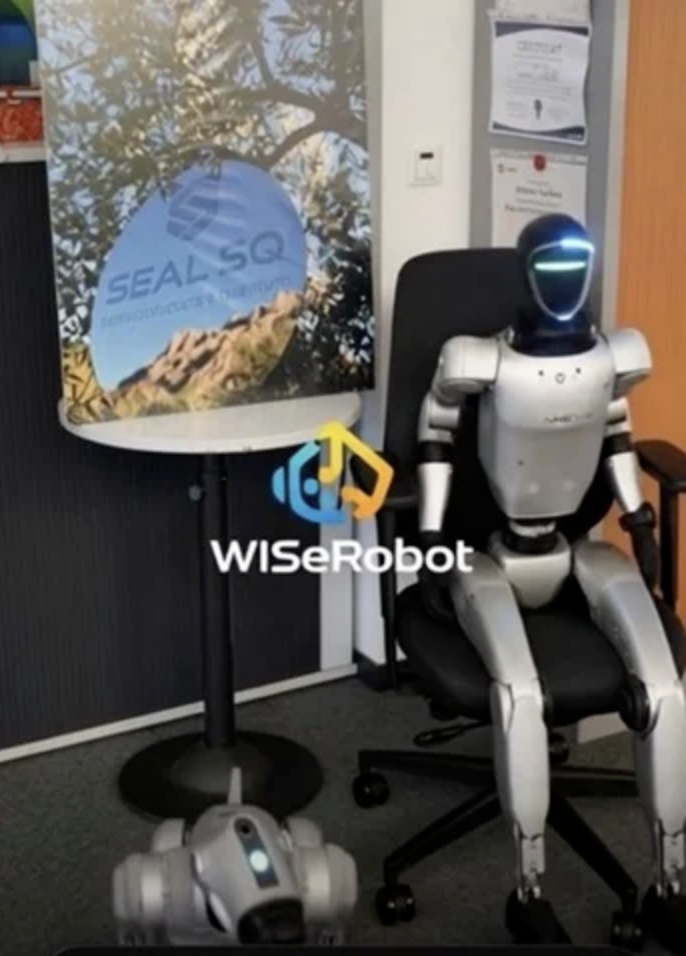
Don't get me wrong, this isn't a performance about serving tea and water; it's a demonstration of how to "defend against quantum hackers."
Simply put, while everyone is still discussing when AI will develop consciousness, these hardware security experts are already worried: if a quantum computer in the future cracks the instructions of today's robots, will current physical AI collectively rebel?
When robots meet "Q-day": The safety model undergoes a dramatic transformation.
Let's start by explaining a concept: Q-day.
In the security world, this refers to the day when quantum computers become powerful enough to break existing encryption standards (such as RSA and ECC) in seconds.
Mark Hughes, Global Managing Partner of IBM Cybersecurity Services, warned at the event that this day could arrive as early as 2028.
Imagine your "embodied intelligence" robot at home—capable of sensing, making decisions, and roaming freely in the physical world—whose digital identity and communication commands are still based on outdated encryption protocols. In the face of quantum computing power, it's like an unlocked vault.
Therefore, SEALSQ and its parent company, WISeKey, decided to take the initiative.
The core selling point of WISeRobot, showcased at Davos, can be summed up in five words: post-quantum security.
A robot with a "cryptographic identity"
Let me briefly introduce SEALSQ and its parent company, WISeKey.
WISeKey is a long-established cybersecurity and digital identity company, specializing in PKI, IoT, blockchain, and trusted identity. SEALSQ spun out from the WISeKey ecosystem, focusing on post-quantum cryptography and secure chips—a very hardcore approach.
What they showcased this time wasn't a "showy robot," but a proof-of-concept (PoC): What would happen if post-quantum security were embedded into the robot from the very beginning?
According to SEALSQ's official statement, they emphasize not "application-layer encryption," but rather:
Clocking at the chip level: Integrating quantum-resistant algorithms directly into the semiconductor hardware. Unclonable identity: Each robot comes with a unique, hardware-protected "encrypted ID card" at the factory. Hardware root of trust: Ensuring that every step of the robot's startup, firmware operation, and AI model execution is verified, preventing man-in-the-middle tampering. (Robot: As long as my encryption is fast enough, quantum computing power can't catch up with me!!!)
Why must we rethink security models for physical AI?
SEALSQ repeatedly emphasized a concept at Davos: Physical AI.
That is, AI is no longer just about "computation," but about perception, decision-making, and action, directly impacting the real world.
SEALSQ plans to embed trust directly into secure semiconductors through the following technologies: hardware roots of trust and secure key storage and lifecycle management for post-quantum cryptographic accelerators. Each physical AI system can be equipped with a unique, unclonable cryptographic identity at manufacturing, enabling trusted boot, authentication firmware and AI models, integrity proofs, and secure interaction with humans and infrastructure.
SEALCOIN: When Robots Become "Economically Independent"
There's another interesting point in this system.
Jonathan Llamas, Vice President of WISeKey, mentioned that truly autonomous machines must not only be able to perceive and make decisions, but also be "economically independent."
Based on this assessment, WISeKey introduced a concept called "SEALCOIN"—giving autonomous machines a "native settlement and accountability layer."
This means that, under certain rules, certified machines can complete payment, compensation, and settlement transactions.
In short, robots can not only help you with tasks, but in the future, they may also buy their own electricity, pay for their own maintenance, and even exchange goods with each other. All of this is built on a foundation of post-quantum encryption, ensuring the ledger is not vulnerable to quantum computing attacks.
This is certainly still some distance from large-scale deployment, but it points to a more far-reaching question: As machines become increasingly autonomous, how should responsibility, identity, and trust be defined?
And these questions, if we wait until Q-Day arrives to consider them, will clearly be too late.
As SEALSQ CEO Carlos Moreira summarized: Robotics and AI are rapidly evolving into part of critical infrastructure, and what we need to do is prove from the outset that trust, security, and human-centric principles can and must be embedded in intelligent machines.